The best law firm websites: 8 traits worth checking.
Most law firm website roundups are screenshot galleries. This guide focuses on what a prospective client can actually verify: matter fit, attorney identity, substantive practice pages, current disclosures, a clear next step, and a site that works on a phone. One live TMN build is shown against the list.
- 8 checks
- Use on any firm site
- 1 live firm
- Publicly credited
- Florida example
- Rules vary by jurisdiction
- $2,250+
- Published TMN pricing
8 traits, each one checkable.
Open any firm's site, including your own, and review it. Anything you cannot verify in a few minutes is not a standard, it is an opinion.
The first screen answers “can you help me?”
Not a slideshow of a courthouse. A visitor should learn the practice type, the geography, and who the lawyer is before scrolling. A stock gavel and a slogan occupy the most valuable space on the page without answering either question.
Credentials a stranger can verify
Bar number, jurisdiction, and standing, ideally linked to the bar's own directory. A claim the reader can check independently carries more weight than adjectives, and it is uncommon enough on firm sites to stand out.
Practice areas as real pages
Each priority practice area deserves a useful page, not a dropdown item and one sentence. A focused page can answer the question a visitor searched and create a crawlable source that search engines and AI systems can evaluate and potentially cite.
The law explained in plain language
Deadlines, insurance rules, and procedural traps written so a non-lawyer understands them, with citations. This demonstrates competence instead of asserting it, and it stays useful to visitors who never call.
One obvious next step
A single primary action, repeated. Offering a phone number, a form, a chat widget, and a calendar at once is 4 decisions instead of 1. Pick the path you actually answer fastest and make it the loudest thing on the page.
Jurisdiction-specific advertising review
Required identity and location information, expertise or certification language, testimonials, and results need review under the rules that apply to the firm. The site should make accurate disclosures easy to find. The firm and its counsel approve what is published.
Fast on a phone
Injured people and anxious clients often search from phones and uneven connections. Keep the first screen useful, compress media, avoid blocking scripts, and test the actual intake path. Faster is valuable, but the target should be measured on the real production site.
Nothing invented
No stock-photo team posing as your associates, no testimonials your state may prohibit, no vague awards nobody can trace. Every unverifiable element is a small withdrawal from trust.
One live firm site, reviewed against all 8.
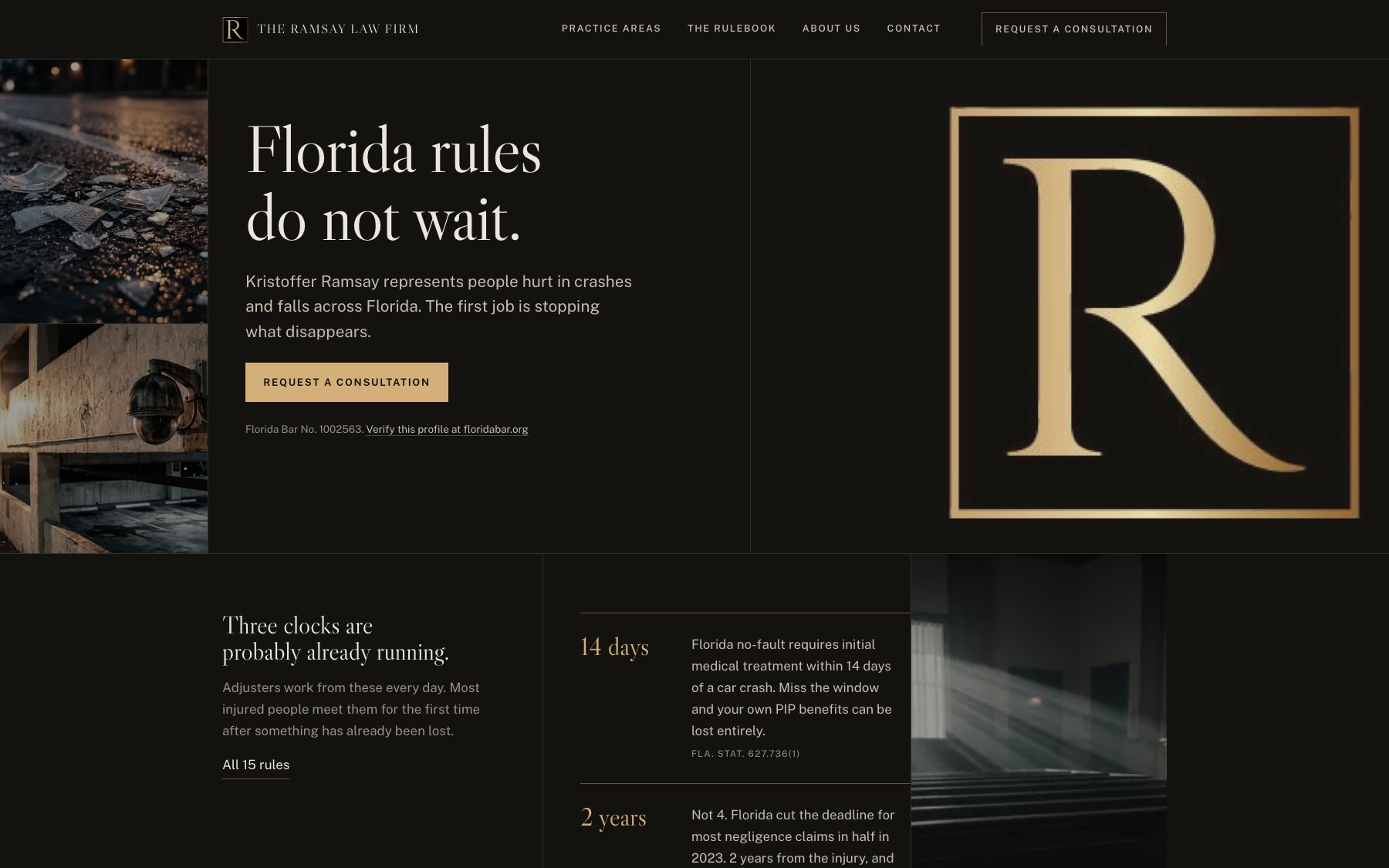
The Ramsay Law Firm, P.A., a Fort Lauderdale personal injury practice TMN built and launched in August 2026. The review below separates what is publicly visible from what only the firm can confirm.
First screen and credentials
The opening line is a Florida deadline rather than a slogan, followed by the practice type and geography. The Bar number appears in the first screen with a link to the Florida Bar directory, so standing is confirmed by the Bar rather than asserted by the firm.
The law, in plain language
The site publishes 15 cited Florida deadlines and rules, using statutes and reported authority. Examples include the 14-day PIP initial-services window and the current 2-year limitations period that applies to many general negligence claims, subject to exceptions and accrual rules.
Firm review and restraint
The site names the responsible lawyer and location, publishes the firm's aggregate career settlement statement with a visible past-results disclaimer, avoids unsupported expertise claims, and uses form-first calls to action because no public firm phone number was supplied for the build. Advertising language was prepared for firm review.
| Check | What is visible | Boundary |
|---|---|---|
| 1. First-screen fit | Present. The opening identifies a Florida personal-injury issue, the firm, and the geography before the visitor has to hunt. | This checks clarity, not whether the firm is right for a particular matter. |
| 2. Verifiable credentials | Present. The responsible lawyer and Florida Bar number are named, with a link to the Bar's directory. | The Bar directory, not TMN, is the source for current standing. |
| 3. Practice-area depth | Present. Priority personal-injury matters have dedicated pages instead of living only in navigation labels. | Page depth does not predict rankings or case volume. |
| 4. Cited explanations | Present. The site publishes plain-language Florida deadlines and rules with linked statutes or reported authority. | The pages are general information and are not legal advice. |
| 5. One next step | Present. The site consistently uses a form-first consultation path. | No public firm phone number was supplied for this build. |
| 6. Advertising review | Partly observable. The lawyer, office, and general disclaimers are visible. | Only the firm and its counsel can confirm jurisdiction-specific approval. |
| 7. Mobile performance | Responsive layout present. The intake path and core content remain available at phone widths. | No speed score is published here without a dated production test. |
| 8. No invented proof | A firm-supplied result claim is disclosed. The reviewed pages publish an aggregate career settlement statement with a visible past-results disclaimer. No unverifiable award language was seen. | Public review confirms the wording and disclaimer, not the underlying settlement records. The firm and its counsel own substantiation and approval. |
Open the live firm site and repeat the same review. Requirements vary by jurisdiction.
Read the full Ramsay Law Firm case study or open the live site, which credits TMN publicly. See how to verify any claim TMN makes.
What firm owners ask about this.
What makes a good law firm website?
A first screen that answers matter fit, credentials a reader can verify, useful practice-area pages, cited legal explanations, one obvious next step, jurisdiction-specific advertising review, strong mobile performance, and nothing invented. Design quality supports those fundamentals.
Do law firm websites actually bring in cases?
They can support consultations when they answer the question the person searched and give a clear next step. Many legal searches begin with a problem or deadline rather than a firm name, so useful practice content matters before the contact form.
Should a small law firm copy a large firm's website?
No. Large-firm sites are built for recruiting, institutional credibility, and existing referral relationships. A small firm needs the opposite: a specific practice focus, a named lawyer, and a direct path to a consultation. Copying the big-firm look usually makes a small firm read as generic.
What should a law firm website show if the firm has no case results?
Build credibility with what is verifiable instead: bar credentials the reader can check and plain-language explanations of the deadlines and rules that may affect the matter. Case-result claims can trigger different review and disclosure requirements depending on the jurisdiction and wording, so the firm should check its bar rules and consult counsel before publishing them.
How much does a good law firm website cost?
TMN builds firm sites from $2,250 for an Essential Website, $3,750 for a Full Site Rebuild, and $5,000+ for a Custom Studio Build. See law firm website design cost for the full market picture including platform and agency routes.
How do I evaluate my current law firm website?
Review it against the 8 traits above. If you would rather have a second opinion, TMN builds a free homepage preview in 48 hours showing what a rebuild would look like, with no commitment. Request one here.
Ready to get started?
Tell us about your operation. We’ll put together a free custom homepage so you can see the direction before committing. No retainer. No pressure.