Attorney advertising rules for law firm websites: what a bar-aware build checks.
Every page of a firm website is a communication about legal services, and the state bar reads it that way. This guide covers the 9 decisions the advertising rules shape on a site, how Florida and Texas differ on filing, and how TMN prepares content so the firm's review is short. One live firm build is shown against the list.
- 9 decisions
- The rules shape on a site
- 2 states
- Florida and Texas compared
- 1 live firm
- Publicly credited
- $2,250+
- Published TMN pricing
Your bar decides which rules the website answers to.
The ABA Model Rules are the template most states start from. Each state then adds its own filing, disclosure, and testimonial rules. The build starts by naming the jurisdiction, the responsible lawyer, and the bar number, because those 3 facts change what can go on the homepage.
ABA Model Rules 7.1, 7.2, 7.3, 1.18, and 5.3
Rule 7.1 bars false or misleading communications, including truthful statements that create unjustified expectations. Rule 7.2 covers advertising, regulates claims that a lawyer is certified as a specialist, and requires the name and contact information of a responsible lawyer or firm. Rule 7.3 governs solicitation, which a public website generally is not. Rule 1.18 covers prospective clients who write in through the site, and Rule 5.3 makes the lawyer responsible for supervising nonlawyer vendors, including the web designer.
Rules 4-7.11 to 4-7.23, no filing for a plain website
The Florida Bar publishes a website and social media checklist. It states that websites need not be filed unless they are sponsored, boosted, or promoted, and it warns that answering every checklist question does not by itself mean the advertisement complies. The substantive rules still apply: required name and office-location disclosures, no predictions or guarantees, no unverifiable past results, and certification claims limited to board-certified lawyers.
Part VII rules, Advertising Review Committee filing
Texas Rule 7.04 requires non-exempt advertisements to be filed no later than 10 days after dissemination and allows optional pre-approval at least 30 days before first dissemination. Rule 7.05(b) exempts information and links posted on a law firm website except the homepage content, unless the homepage content is otherwise exempt. The entire site still must comply with Rules 7.01 and 7.02. The firm confirms its filing path with the committee.
Other states follow the same pattern with their own filing and testimonial rules. If your bar is not Florida or Texas, the checklist below still applies. The filing answer is the one you confirm locally.
9 website decisions the advertising rules shape.
Open your current site and check each one. These are the items a bar reviewer or an opposing counsel would look for first, and the items TMN resolves before the firm sees a draft.
A responsible lawyer and a real office location
Model Rule 7.2(d) requires the name and contact information of at least 1 lawyer or firm responsible for the content. Florida Rule 4-7.12 adds the city, town, or county of a bona fide office. On a site this means the responsible lawyer's name and the office location appear on every page, usually in the footer, and the bar number links to the bar's own directory so the reader can verify standing.
Expert, specialist, and certified language
Model Rule 7.2(c) addresses the narrower claim that a lawyer is certified as a specialist and requires a qualifying certification with the certifying organization named. Florida separates certification from specialist or expert language: certification requires board certification, while specialization or expertise must be objectively verifiable through certification, education, training, experience, or substantial involvement. TMN treats each term as a review trigger and publishes it only when the firm can substantiate and approve the exact wording.
Past results and outcome claims
A truthful result can still be misleading under Rule 7.1 if it creates an unjustified expectation. Florida prohibits predictions or guarantees of success and past results that cannot be objectively verified. The safe default for a new firm is no results at all. A firm with results publishes only the ones it can document, with the disclaimer its rules require.
Testimonials and republished reviews
States split here. Florida flags unqualified testimonials without a similarity disclaimer as prohibited content. Copying a Google review onto the homepage makes it the firm's own communication, reviewed as advertising. Decide the testimonial policy with counsel before the layout is drawn, because a review carousel is a different homepage than a rulebook.
Stock people, staged scenes, and dramatizations
Florida requires a clear disclaimer when an image or voice would make a reasonable viewer think a person is a firm member or employee when they are not. It also addresses dramatizations and actors portraying specific occupations when the fictional presentation would not be apparent. Ordinary illustrative photography does not automatically trigger that exact disclaimer. TMN does not present stock people as a firm's attorneys, staff, or clients.
Practice areas the firm actually handles
Florida prohibits advertising in a practice area the lawyer does not practice. Navigation labels, service pages, and schema markup are all claims. A practice-area page exists because the firm takes those matters, not because the phrase has search volume.
Fee and free-consultation wording
Florida Rule 4-7.14 requires quoted fees to disclose additional costs and requires contingency language to say who is responsible for expenses if there is no recovery. “No fee unless we win” is exactly the sentence a reviewer reads twice. The site uses the wording the firm's fee agreement actually supports.
Intake forms and prospective clients
Model Rule 1.18 governs what the firm owes someone who writes in before becoming a client. The form states that submitting it does not create an attorney-client relationship, asks for contact details and a short description rather than the whole file, and routes to an inbox the firm actually monitors. Form-first intake also avoids publishing a phone number that does not exist yet.
Firm name and trade name consistency
Florida Rule 4-7.21 requires a fictitious firm name to appear consistently across all firm materials. The name on the site, the footer, the schema, the Google Business Profile, and the bar directory should match character for character. Mismatches read as a different firm to a reviewer and to an AI assistant answering a search.
One live firm site, reviewed against the list.
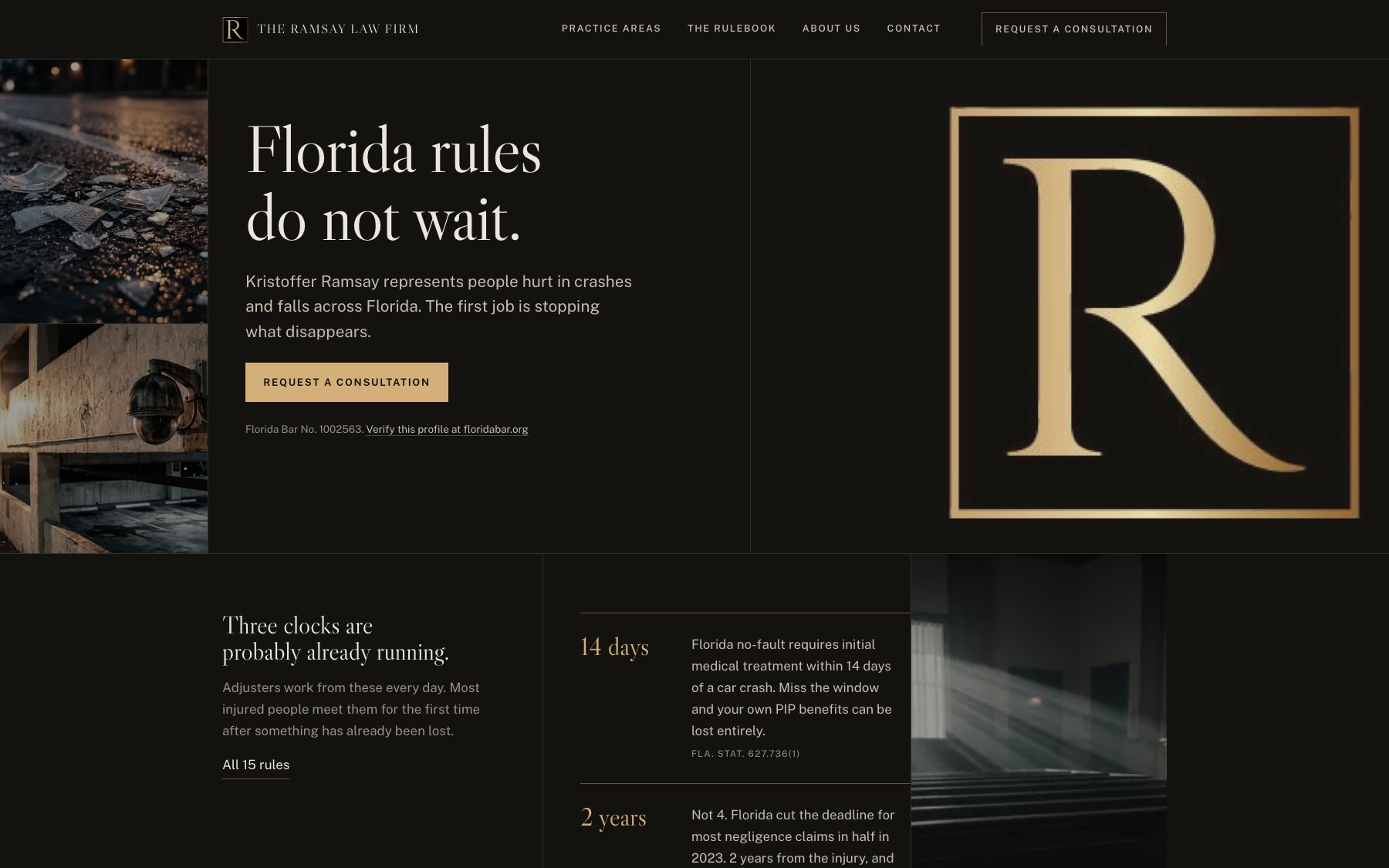
The Ramsay Law Firm, P.A., a Fort Lauderdale personal injury practice TMN built and launched in August 2026. The table separates what is publicly visible from what only the firm and its counsel can confirm.
| Decision | What is visible | Boundary |
|---|---|---|
| 1. Responsible lawyer and office | Present. Kristoffer S. Ramsay is named, the office city is shown, and Florida Bar No. 1002563 links to the Florida Bar directory. | The Bar directory, not TMN, is the source for current standing. |
| 2. Specialist language | None used. The reviewed pages do not describe the lawyer as an expert, specialist, or certified. | A bounded visible-content review of the pages checked. |
| 3. Past results | Published with a disclaimer. The firm states an aggregate career settlement amount and places a visible past-results disclaimer beside it and in the site footer. | A public review confirms the wording and disclaimer, not the underlying settlement records. The firm and its counsel own substantiation and approval. |
| 4. Testimonials | None published. No reviews, ratings, or client quotes appear. | A new firm had none to publish, which also avoided the disclaimer question. |
| 5. Stock people | None used. No stock team photo shipped. No attorney photo shipped either, because no current headshot existed. | Image choices after launch are the firm's. |
| 6. Practice areas | Present. Priority personal-injury matters have dedicated pages that match the firm's stated practice. | Only the firm can confirm its full matter intake. |
| 7. Fee wording | Contingency-style wording is published. The attorney page says, “No money is owed unless you win.” | A public review confirms the phrase, not the engagement agreement or how costs and expenses are handled. The firm and its counsel own the wording. |
| 8. Intake form | Present. Calls to action are form-first because no public firm phone number was supplied at build time. | Form disclaimer wording is the firm's to approve. |
| 9. Filing | Not applicable on its face. Florida's checklist says a website need not be filed unless boosted or promoted. | TMN filed nothing and approved nothing. The firm retained final legal and advertising approval. |
TMN used the Florida Bar's current website checklist as a review input on this build. Open the live firm site and repeat the review. Read the full Ramsay Law Firm case study or see how to verify any claim TMN makes.
Content prepared so the firm's review is short.
TMN is not a law firm and does not approve or file anything. What TMN does is make the firm's review fast by handing over a site where every claim already has a source and every disclosure already has a place.
Jurisdiction, lawyer, and bar number first
Before design starts, TMN records the state, the responsible lawyer, the bar number, the office location, and any certifications the firm holds. Those facts set the footer, the hero, and the words the copy may not use.
Copy drafted without the trigger words
No expert, specialist, best, guaranteed, or win-rate language unless the firm supplies the basis. Legal explanations cite the statute or the reported case. Nothing goes on the page that could not be sourced.
Disclosures structured, not buried
Responsible-lawyer line, office location, general-information disclaimer, and intake-form language are placed where a reviewer expects them and where a reader can actually find them. The firm edits the wording. TMN builds the placement.
Firm review on a private staging link
The complete site sits on a private URL until the firm and its counsel approve it. Anything they cut or change is applied before launch, and changes after launch run through Site Care the same way.
The bar's own checklist as an input
Where the bar publishes a checklist, TMN reads it before drafting. On Ramsay that was the Florida Bar's website and social media checklist. It is a review input, not a substitute for the firm's judgment or its counsel's.
Priced like the rest of TMN's work
Firm sites start at $2,250 for an Essential Website, $3,750 for a Full Site Rebuild, and $5,000+ for a Custom Studio Build. Compliance-aware drafting is part of the build, not an add-on. See law firm website design cost.
What firm owners ask before a build.
Is a law firm website considered attorney advertising?
In most jurisdictions a public website that describes a lawyer's services is a communication about those services and falls under the state's advertising rules, which are usually modeled on ABA Model Rules 7.1 and 7.2. Under the Model Rules' framing it is not solicitation, because it is directed to the general public rather than to a specific person, but the truthfulness, disclosure, and specialist-language rules still apply to every page.
Do I have to file my website with the state bar?
It depends on the state and the material. The Florida Bar's website checklist states that a lawyer's own website generally need not be filed unless it is sponsored, boosted, or promoted. In Texas, Rule 7.05(b) exempts website information and links beyond the homepage. Homepage content may require filing unless another exemption applies, and the entire site still must comply with Rules 7.01 and 7.02. Confirm current exemptions and timing with your bar before launch.
Can I put Google reviews or testimonials on my law firm website?
Some states allow testimonials with conditions and others restrict them. Florida's checklist flags unqualified testimonials without a similarity disclaimer as prohibited content. Republishing a Google review on your own site is your communication, so it is reviewed as advertising. Decide with counsel before the build, because the answer changes the homepage layout.
Can my website say I am an expert or specialist?
Not automatically. ABA Model Rule 7.2(c) regulates a claim that a lawyer is certified as a specialist. Florida separately permits specialist or expert language only when it is objectively verifiable through certification, education, training, experience, or substantial involvement, with an additional qualifier for some firm-wide claims. Requirements vary, so TMN treats certified, specialist, and expert as separate review triggers and publishes only substantiated wording the firm approves.
Who is responsible if the web designer publishes something that violates the rules?
The lawyer. ABA Model Rule 7.2(d) requires the name and contact information of a lawyer or firm responsible for the content, and Model Rule 5.3 makes lawyers responsible for supervising nonlawyer assistance, including vendors. That is why TMN prepares content for firm review and the firm gives final approval before anything goes live.
Does TMN Creative provide attorney advertising compliance advice?
No. TMN prepares bar-rule-aware copy, cites sources, structures disclosures, and uses the bar's published checklist as a review input, as it did on The Ramsay Law Firm build. The firm and its counsel approve what is published and handle any filing. The page you are reading is general information, not legal advice.
Want a site your counsel can approve in one pass?
Tell us the jurisdiction and the practice. We’ll build a free homepage preview in 48 hours so you can see the direction before committing. No retainer. No pressure.